
Think of a solar module’s junction box as the gateway to its central nervous system. It’s the critical connection point where all the energy harnessed by the solar cells is channeled out to the world. Everything can be perfect—the cells, the glass, the frame—but if this small, unassuming box fails, the entire module is compromised.
The silent threat? A tiny gap, an air bubble, or a weak bond in the seal. To the untrained eye, it’s invisible. But over years of exposure to rain, heat, and humidity, that microscopic flaw can become a pathway for moisture, leading to corrosion, electrical failure, and significant safety risks.
This guide will train your eye to spot the visual cues that separate a robust, reliable junction box seal from one that’s a failure waiting to happen.
Why the Junction Box Seal is a Mission-Critical Component
The junction box has two primary jobs: providing a secure point for external electrical connections and protecting those connections from the environment. The materials used to seal it—typically a potting compound and an adhesive—are essential for both performance and safety.
They serve two key roles:
- Electrical Insulation: The potting compound fills the interior of the box, surrounding all live electrical parts. This prevents short circuits and protects components from vibration and impact.
- Environmental Barrier: The adhesive creates an impermeable seal between the junction box housing and the module’s backsheet. This is the primary defense against moisture ingress.
According to international safety standards like IEC 61730, a compromised junction box seal is a major failure. When moisture gets in, it can lead to corroded terminals, ground faults, short circuits, and in the worst cases, a serious fire hazard. This isn’t just about performance loss; it’s about long-term operational safety.
The Anatomy of a Perfect Seal: What to Look For
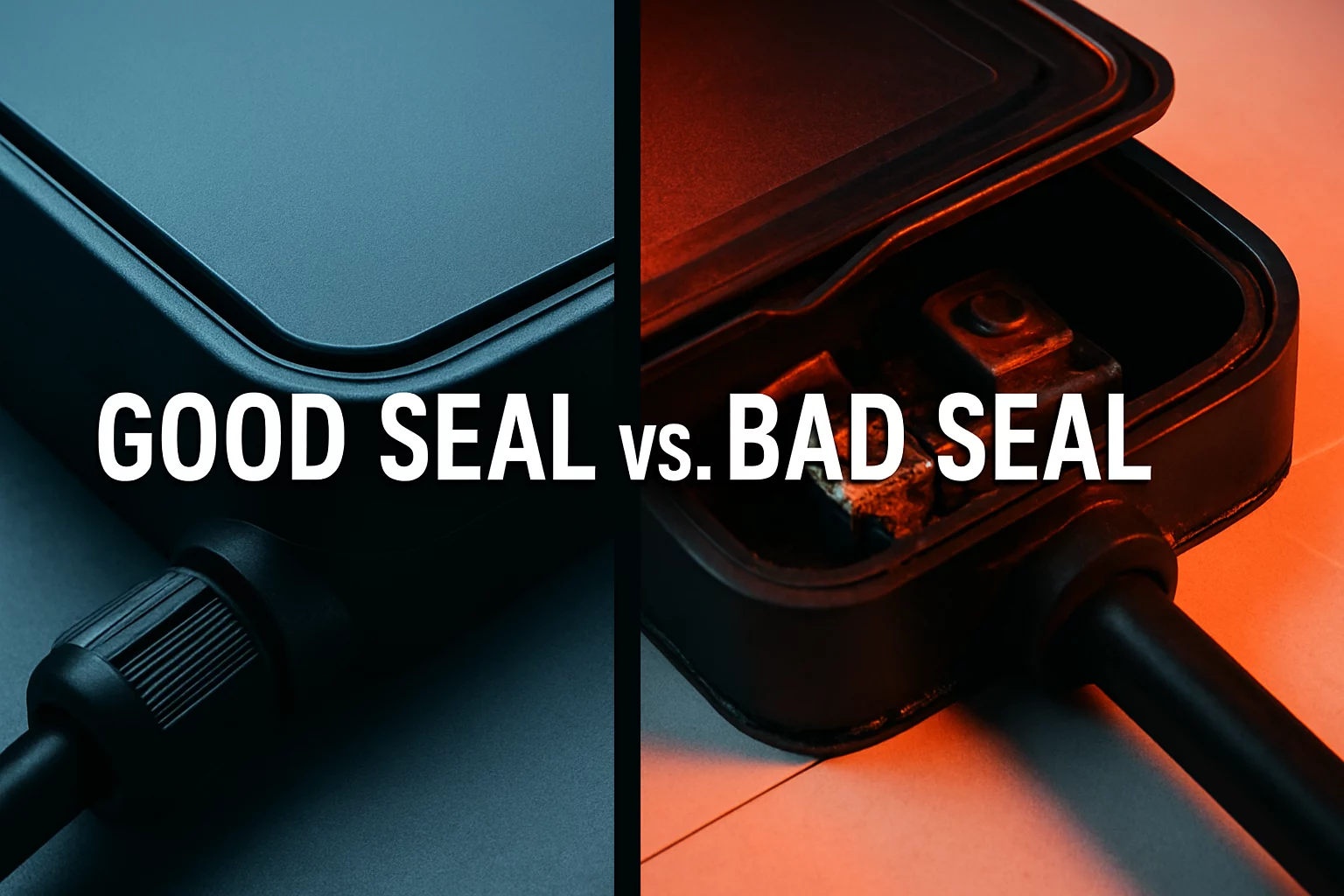
Before we dive into defects, let’s establish our benchmark. A perfectly executed junction box seal is clean, complete, and consistent.
You should see a uniform bead of adhesive around the entire perimeter where the box meets the backsheet, with no gaps or lifting. Inside, the potting compound should completely encapsulate all wires and terminals, forming a solid, void-free fill. It looks robust because it is. This level of quality is the result of a meticulously controlled manufacturing process, where material selection and application parameters are perfectly matched.
Common Defects and Their Hidden Dangers: A Visual Checklist
With our benchmark established, let’s examine the common culprits behind junction box failures. These are the visual red flags that every quality inspector and product developer should be able to spot immediately.
Voids and Air Bubbles
Voids, or air bubbles, trapped within the potting compound are more than just cosmetic blemishes. Each bubble is a potential pocket where air and moisture can collect. More importantly, they create weak points in the electrical insulation, reducing the module’s ability to withstand high voltage stresses over its lifetime. Improper mixing of the potting compound or a flawed dispensing process are the usual causes.
Incomplete Potting Fill
An incomplete fill occurs when the potting compound doesn’t fully cover all internal components, leaving electrical terminals or bypass diodes exposed. This is a critical defect. Exposed live parts are a major safety risk and more susceptible to corrosion and failure from vibration. This flaw also hinders heat dissipation from the diodes, causing them to overheat and fail prematurely.
Poor Adhesion and Delamination
This is perhaps the most dangerous defect. Delamination is the physical separation of the junction box adhesive from the module backsheet, creating a direct path for water to enter the enclosure. This failure often stems from deeper process issues, such as:
- Surface Contamination: Release agents from the backsheet manufacturing process, dust, or oils can prevent the adhesive from forming a strong bond.
- Incorrect Curing: The adhesive may require a specific temperature and time to cure properly. Deviations can result in a weak, unreliable bond.
- Poor Material Compatibility: Not all adhesives work well with all backsheet materials. Ensuring proper material compatibility is a fundamental step in module design that is often overlooked.
Visually, you’ll see the adhesive peeling away from the backsheet, creating a visible gap. Even a small area of delamination can compromise the entire module.
The Domino Effect: How a Small Gap Leads to Big Problems
It’s easy to underestimate how a small sealing flaw can escalate. Let’s follow the chain of events:
- A tiny gap from delamination allows a minuscule amount of moisture inside during a rainstorm.
- The sun comes out, and the module heats up, causing the trapped moisture to turn into high-pressure vapor. At night, it condenses back into water.
- This daily thermal and pressure cycling slowly widens the gap, allowing more moisture in.
- The water begins to corrode the metal terminals and solder joints.
- Corrosion increases electrical resistance, which generates heat and reduces power output.
- Eventually, the corrosion can lead to a broken circuit or, worse, an electrical arc that can cause a fire.
This gradual degradation is why initial quality control and robust testing of module durability and reliability are so essential. What appears to be a minor issue at the factory can become a catastrophic failure five years down the line.
Beyond Visuals: The Science of a Secure Bond
While visual inspection is a powerful tool, true quality is built into the process. Achieving a perfect seal depends on a deep understanding of material science and process control.
The curing of the potting compound and adhesive, for instance, is a delicate chemical reaction that depends on precise time and temperature control. This step is often integrated with or follows the solar module lamination process, and any deviation can compromise the bond’s strength and longevity. Furthermore, the surface energy of the backsheet plays a crucial role. Some materials require special surface treatment to ensure the adhesive can „wet“ the surface and form a strong, permanent molecular bond.
Frequently Asked Questions (FAQ)
What is junction box potting?
Potting is the process of filling a junction box with a liquid insulating compound (like silicone or epoxy) that cures to become a solid, protective barrier. It insulates electrical components, protects them from moisture and vibration, and helps dissipate heat.
Can a faulty junction box seal be repaired in the field?
Generally, no. A compromised seal identified in the field is a sign of a manufacturing defect. Field repairs are often temporary fixes that cannot replicate the durability and protection of a factory-applied seal, and they typically void the module’s warranty and safety certification.
What’s the difference between the potting compound and the adhesive?
The potting compound fills the inside of the box for insulation and protection. The adhesive is applied to the perimeter of the box to create a seal against the backsheet. In some designs, a single material is used for both potting and adhesion.
How are these seals tested professionally?
Beyond visual inspection, the primary mechanical test is the „junction box pull test“ as specified by standards like IEC 61215. This test applies a specific force to the box to ensure it remains securely adhered to the module backsheet without any delamination.
Does the type of backsheet material affect the seal’s quality?
Absolutely. Different backsheets (like TPT, PET, or fluorine-free variants) have different surface properties. The adhesive must be chemically compatible with the specific backsheet material to create a durable, long-lasting bond.
From Visual Checks to Process Mastery
Identifying a bad junction box seal is a critical skill, but preventing it from ever happening is the ultimate goal. A reliable seal isn’t a matter of chance; it’s the outcome of meticulous process engineering, rigorous material selection, and a deep understanding of how different components interact under real-world conditions.
Understanding these failure modes is the first step. The next is mastering the processes that prevent them. By building quality in from the start, manufacturers can ensure their modules are not just powerful on day one, but safe and reliable for decades to come.