
The alert flashes on the production manager’s screen: LAMINATOR 3 – FAULT. The entire line grinds to a halt. Every minute that machine sits idle, the financial clock is ticking—loudly. For many large manufacturing plants, a single minute of downtime can cost over $5,600. While the numbers might be different for your solar module facility, the principle is the same: unplanned stops are silent profit killers.
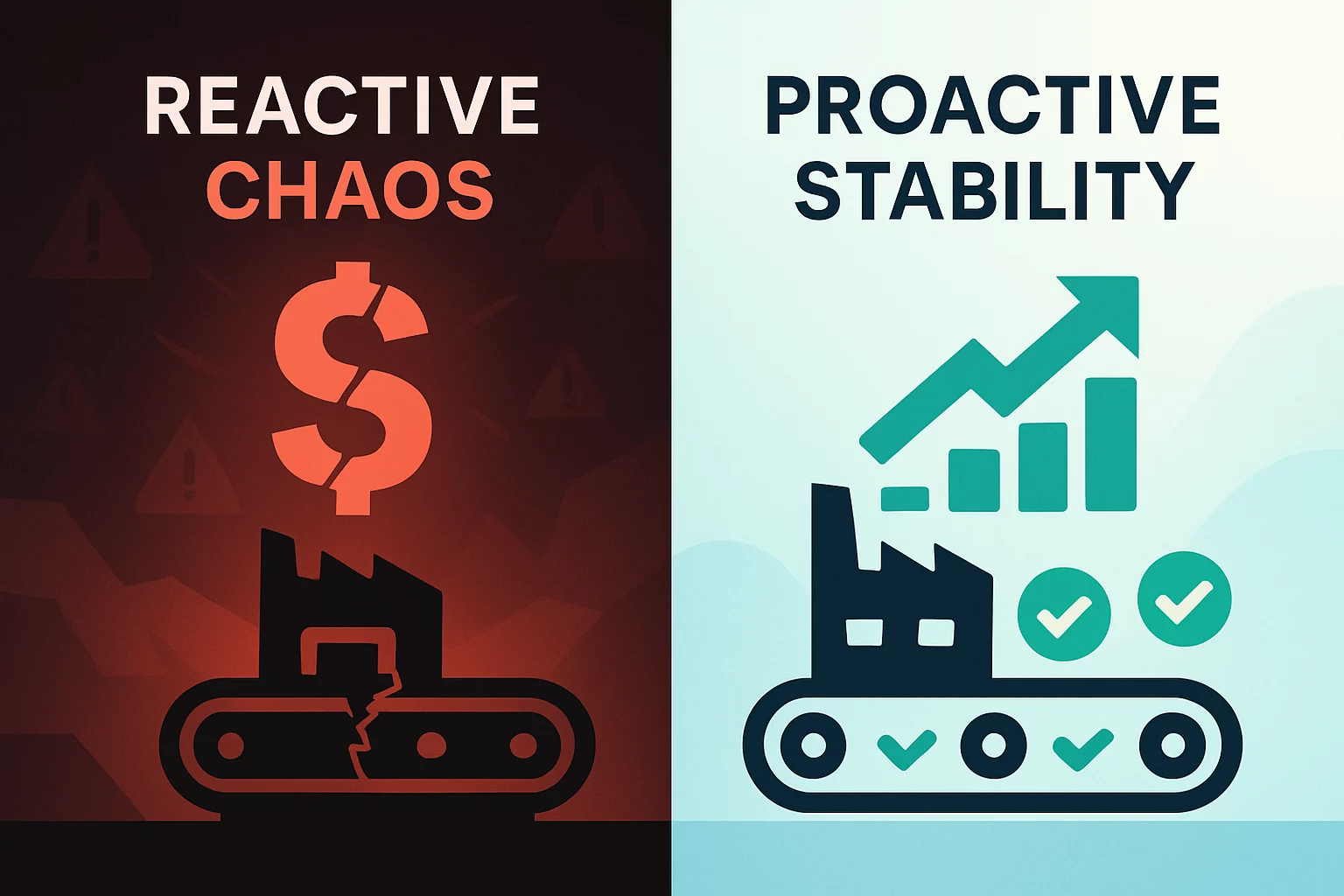
Most teams are experts at reactive firefighting—diagnosing the alarm, cleaning the equipment, and restarting the line. But what if the root cause isn’t a random mechanical failure? What if the problem started weeks ago, when you introduced a new backsheet or encapsulant that seemed fine on the datasheet but was slowly destabilizing your most critical process?
This is the unseen cost of process instability. It’s not just about the hours lost during a shutdown; it’s about the hidden inefficiencies that lead up to it. In this article, we’ll model the true financial impact of an unstable lamination process and explore how proactive validation is one of the most powerful tools for protecting your uptime and profitability.
What is „Process Stability“ and Why Does It Matter in Lamination?
Imagine you have a perfect recipe for a cake. You know the exact ingredients, temperatures, and timings to get a flawless result every time. „Process stability“ in manufacturing is the same concept: it’s about achieving a predictable, repeatable outcome for every single solar module that comes off your line.
The lamination process is the heart of module manufacturing—it’s where glass, encapsulants, solar cells, and backsheets are fused into a single, durable unit under intense heat and pressure. It’s the moment your „recipe“ is truly tested.
The challenge arises when you change an ingredient. Introducing a new material, even one with a promising spec sheet, is like swapping out the flour in your cake recipe. It might work perfectly, or it might subtly alter the chemistry, leading to a result that fails under pressure. An unstable lamination process creates unpredictable outcomes, and that unpredictability is the direct enemy of uptime.
The Domino Effect: How Lamination Issues Trigger Costly Downtime
Unplanned downtime rarely happens in a vacuum. It’s often the final, visible symptom of a deeper, invisible problem. According to research from Deloitte, unplanned downtime costs industrial manufacturers an estimated $50 billion annually. In solar, that chain reaction often starts with material incompatibility in the laminator.
Here’s how the dominoes fall:
- The New Material: A new encapsulant is introduced to the line to improve performance or reduce cost.
- The Hidden Reaction: Under the heat and pressure of the laminator, the material releases volatile organic compounds (VOCs) or other residues—a process known as outgassing. This isn’t visible on the finished module.
- The Slow Contamination: Over days or weeks, this residue builds up a thin film on the laminator’s heating plate, vacuum seals, or membrane.
- The Performance Drop: The contaminated components become less efficient. The vacuum pump has to work harder, or heat transfer becomes uneven, leading to inconsistent curing.
- The Unscheduled Stop: Eventually, a sensor trips, a vacuum seal fails, or quality control flags a sudden spike in delamination or bubbling. The line stops. Now, you’re not just fixing a machine; you’re hunting for a root cause that began weeks earlier.
As PV Process Specialist Patrick Thoma explains, „The lamination process is the heart of module manufacturing. An unstable process doesn’t just create delamination; it creates production chaos. It stops the line, forces rework, and bleeds money silently until you trace the problem back to a material incompatibility you could have caught months earlier.“
Modeling the True Cost: Let’s Do the Math
What does a „minor“ 4-hour stoppage actually cost? Let’s model a simplified scenario to make the numbers tangible.
Assumptions for a Hypothetical Production Line:
- Production Rate: 50 modules/hour
- Average Selling Price (ASP): $150/module
- Hourly Revenue: 50 modules/hour * $150/module = $7,500/hour
- Idle Labor Cost: 10 operators * $30/hour = $300/hour
- Energy & Overhead: $200/hour
Calculating the Cost of a 4-Hour Stoppage:
- Lost Revenue: $7,500/hour * 4 hours = $30,000
- Labor & Overhead: ($300 + $200)/hour * 4 hours = $2,000
- Scrapped Material (estimated): $1,000
- Total Immediate Cost: $33,000
This $33,000 figure doesn’t even include the long-term costs of expedited shipping to meet deadlines, the engineering hours spent on diagnosis, or the potential for widespread quality issues. The American Society for Quality estimates that poor quality can cost typical manufacturing companies 15-20% of their total sales revenue. Much of that cost stems from unstable core processes like lamination.
The Proactive Solution: De-Risking Your Process Before It Hits the Factory Floor
If your main production line is the only place you can test a new material, you’re essentially using your most expensive asset as a laboratory. The proactive solution is to decouple testing from production.
By validating how new materials behave in a controlled, real-world environment, you can identify and solve potential issues like outgassing, poor adhesion, or required changes to cycle times before they can ever threaten your uptime. This approach is a cornerstone of proactive maintenance, which the U.S. Department of Energy has found can reduce downtime by up to 45%.
This is achieved through structured R&D activities:
- Comprehensive Material Analysis: Instead of relying solely on datasheets, conducting hands-on lamination process trials reveals how a material interacts with your specific components under industrial conditions.
- Targeted Prototyping: Building small batches of modules through solar module prototyping allows you to test for long-term reliability issues without dedicating a full production run.
- Focused Component Testing: For critical components, dedicated new encapsulant testing can pinpoint potential outgassing or curing problems before they ever enter your factory.
This front-end investment in process validation turns a potentially huge, unpredictable expense (downtime) into a small, predictable R&D cost.
Frequently Asked Questions (FAQ)
What are the first signs of an unstable lamination process?
Early warning signs are often subtle. Look for minor bubbling or delamination in electroluminescence (EL) images, a slight yellowing of the encapsulant after lamination, or your maintenance team having to clean the inside of the laminator more frequently.
Isn’t the material supplier’s datasheet enough?
Datasheets provide specifications under ideal laboratory conditions. They can’t predict how a material will interact with your unique combination of cells, glass, backsheet, and equipment. Real-world validation tests the entire system, not just the isolated component.
How long does it take to validate a new material?
It can vary, but a structured series of trials can often be completed in a few days. That focused effort can provide the data needed to prevent weeks of cumulative downtime and troubleshooting down the road.
Can small changes really cause big problems?
Absolutely. In a high-temperature, high-pressure lamination cycle, even minor variations in material chemistry can lead to significant issues like outgassing, poor adhesion, cell cracking, or long-term degradation that only appears after months in the field.
From Reactive Firefighting to Proactive Engineering
The true cost of downtime is far more than the sum of lost revenue and idle labor. It’s a tax on your innovation, a drain on your team’s morale, and a risk to your company’s reputation for quality and reliability.
Shifting your approach from fixing downtime to preventing it through rigorous process validation is a strategic business decision. It transforms your manufacturing operation from a reactive environment into a proactive, data-driven one. The path to higher uptime, greater profitability, and seamless innovation starts with understanding and controlling the critical processes at the heart of your factory.